- Mar 23
Why Weight Loss Plateaus Happen (And What To Do About Them)
- Eric Benjamin
- Weight Loss and Metabolic Health
- 0 comments
At some point during weight loss, almost everyone experiences the same thing:
The scale stops moving.
You’re eating well. You’re trying to stay active. But progress slows down or stops completely.
This is called a weight loss plateau, and it is one of the most common reasons people give up and is one of the most frustrating phases of weight loss.
The important thing to understand is this:
A plateau is not failure. It is a normal physiological response.
What Is a Weight Loss Plateau?
A plateau happens when your body adapts to the changes you’ve made.
Early in weight loss, progress is often faster. Over time, your body becomes more efficient, and the same habits that worked before may no longer produce the same results.
Most structured weight loss efforts slow after about 3–6 months as the initial calorie deficit narrows, and many people experience plateaus by 6–9 months.

As body weight decreases, energy needs also decrease.
Why Plateaus Happen
1. You Are Burning Fewer Calories
As you lose weight, your body requires fewer calories to function.
A smaller body simply needs less energy.
This accounts for most of the drop in daily energy expenditure.
2. Metabolic Adaptation
In addition to carrying less body mass, there is often a modest adaptive reduction in energy expenditure.
Most of the drop in daily energy expenditure is explained by carrying less body mass. In addition, there is often a small adaptive reduction in resting metabolic rate beyond what would be predicted by weight loss alone.
This is called adaptive thermogenesis, and while it is real, it is usually not the primary driver of a plateau.

Preserving muscle through resistance training helps support metabolism during weight loss.
3. Loss of Muscle Mass
If protein intake is low or strength training is not included, some of the weight lost may come from muscle.
Less muscle means a lower metabolic rate, which can slow further progress.

Small increases in daily movement, such as walking, can meaningfully impact total calorie expenditure.
4. Reduced Daily Movement (NEAT)
As calorie intake decreases, people often move less without realizing it.
Even a reduction of 1,500–2,000 steps per day can eliminate a meaningful portion of your calorie deficit.
5. Tracking Drift
Over time, portion sizes can increase slightly, or tracking becomes less precise.
Even small changes can add up and reduce the calorie deficit.
6. Poor sleep
Poor sleep can increase hunger signals and reduce daily energy expenditure, making plateaus more likely.

Simple, targeted adjustments are often more effective than extreme changes when progress slows.
Before Calling It a Plateau
Not all plateaus are true plateaus.
Ask yourself:
• Has weight been stable for at least 2–4 weeks?
• Have sodium or carbohydrate intake increased? Both can lead to temporary water retention and a higher scale weight.
• Have you recently increased your workouts or exercise intensity (which can cause temporary water retention)?
• For women: could this be related to the menstrual cycle?
Also consider:
If your waist size is decreasing but weight is stable, you may still be losing fat while gaining or maintaining muscle.
What To Do When Weight Loss Stops
The goal is not to make extreme changes. It is to make small, targeted adjustments.
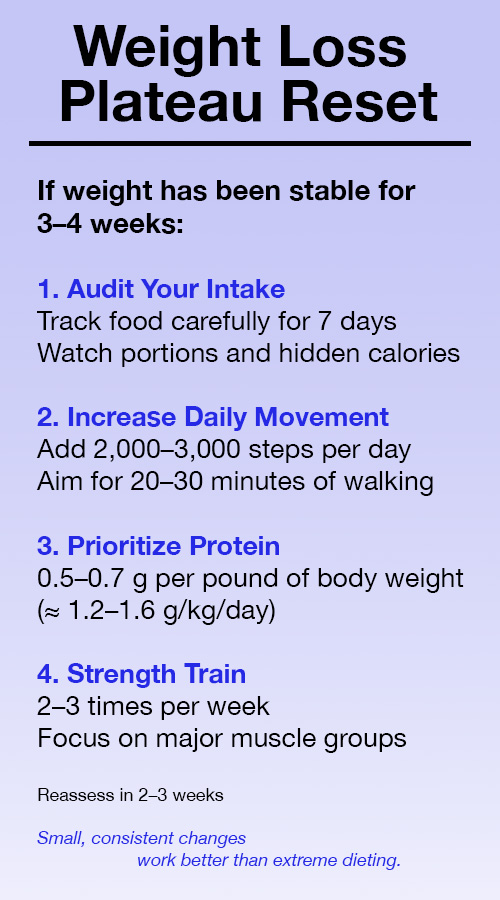
A simple, structured approach to restarting fat loss after a plateau.
A Simple 4-Step Plateau Reset
If weight has been stable for at least 3–4 weeks:
Audit intake for 7 days
This is a good time to track your food on your favorite app again. Tighten tracking and review portion sizes, making sure to be as accurate as possible.Increase daily movement
Add 2,000–3,000 steps per day or 20–30 minutes of walking.Prioritize protein
Aim for approximately 0.5–0.7 grams of protein per pound of body weight per day (about 1.2–1.6 g/kg), spread across meals.Add or progress resistance training
Train 2–3 times per week, focusing on major muscle groups.
Reassess after 2–3 weeks.
Keep this important fact in mind: The closer you get to a healthy body weight, the slower fat loss typically becomes.
Calorie Recalibration
If weight has been stable, your previous intake may now be closer to maintenance.
Recalculate estimated maintenance calories using your current body weight and activity level, then create a modest 300–500 calorie daily deficit.
Avoid aggressive calorie cuts, which can worsen fatigue and muscle loss.
A Note on Cardio
Cardio can help increase energy expenditure, but without dietary precision it rarely overcomes a plateau on its own.
For most people, walking is the most sustainable way to increase daily energy expenditure without increasing injury risk or recovery demands. Remember, this is in addition to, not instead of resistance training.

In some cases, additional medical support may be appropriate when lifestyle changes alone are not enough.
When to Consider Additional Support
In some individuals, especially those with obesity, insulin resistance, or long-standing weight cycling, lifestyle changes alone may not fully overcome biological resistance to weight loss.
In these cases, adjunctive therapies, including medications, may be appropriate and should be discussed with a clinician.
The Bottom Line
Weight loss plateaus are normal and expected.
They do not mean your metabolism is broken.
They mean your body has adapted.
With the right adjustments, progress can continue in a healthy and sustainable way.
Want to Go Deeper?
If you feel like you are doing everything right but not losing fat, there may be a few key factors slowing your progress.
I created a short guide explaining the most common ones I see in clinical practice.
“7 Reasons You Are Not Losing Fat.”
Eric Benjamin, PA-C
Preventive & Metabolic Health
Eat well. Move often. Age boldly.